
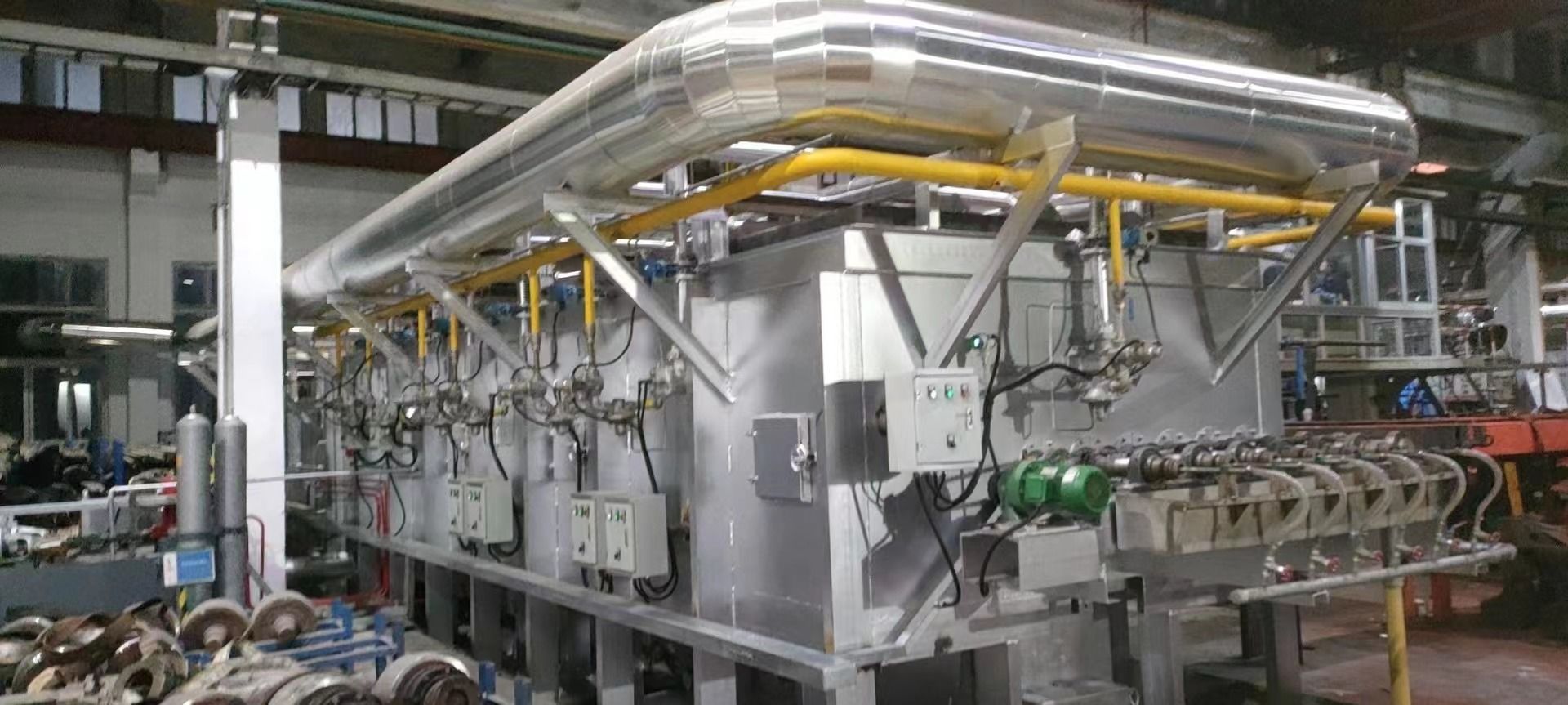
The walking-beam heating furnace adopts a natural gas open-flame heating mode. It transports billets stepwise within the furnace chamber via the cyclic motion sequence of the furnace bottom and metal beams: lifting, advancing, lowering, and retracting. Common Furnace Models QB-40, QB-50, QB-60, QB-76, QB-90, QB-100

Core Technical Advantages
Modular Full-Fiber Movable Furnace Roof
The furnace roof is constructed as a full-fiber movable cover, with flue gas ducts arranged on both sides—facilitating hoisting and rapid maintenance. The dual-side fixed structure of the full-fiber movable roof prevents detachment, ensuring long-term durability; in emergency repair scenarios, in-furnace maintenance can be carried out within 24 hours.
Low-Heat-Capacity Lining Materials
The furnace interior is lined with magnesia bricks and refractory fibers. This combination minimizes heat absorption during heat storage and reduces the overall weight of the furnace lining, contributing to lower energy consumption during startup and shutdown.
Preheated Air-Cooled Moving Bed
The walking beam (moving bed) of the furnace is cooled by preheated air. This design enhances the bed’s wear resistance and service life while simplifying routine maintenance procedures.
Patented Optimized Hydraulic Cylinder System
The furnace’s hydraulic cylinder system has undergone structural optimization, achieving dual benefits: reduced hydraulic oil consumption and fast, stable motion performance. This system has been granted a national patent (patent details can be supplemented as needed for academic traceability).
Foundation-Flexible Frame Structure
Adopting a frame-type structural design, the furnace supports both micro-foundation and foundation-free installation configurations based on customer requirements: it can either be placed on a slightly excavated base or directly on the ground, significantly reducing the customer’s foundation construction costs.
Automatic Feeding Centering Device
Equipped with an automatic centering device for billet feeding, the system self-adjusts to center billets during operation without manual intervention—simplifying operator workflows. A key constraint is that the billet length must exceed the width of the moving bed to ensure effective centering.
Latest projects completed